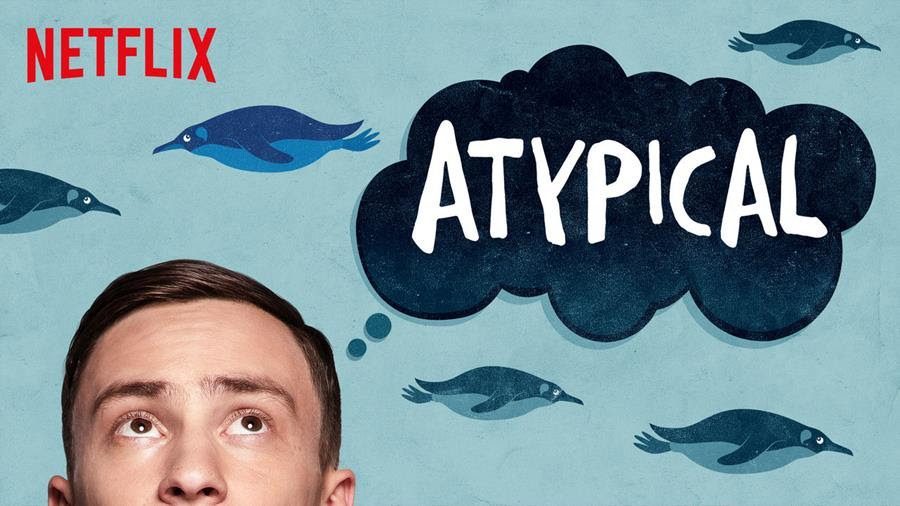
Eighteen-year-old Sam Gardner is
your typical high school boy who loves his family, sports etc. except there’s
one thing that makes him slightly different. Sam is on the autism spectrum (ASD). Atypical, it is a coming of age Netflix series
that takes its viewers on a wild ride with Sam Gardner and his daily struggles
with being a high school student with autism. The first season begins with what
any teenage boy enjoys, girls. Sam Gardner begins asking advice from father
about girls and dating and is welcomed with loads of advice from his father, Doug.
But from his mother, Sam receives almost complete resentment and negativity
when bringing upon the idea of dating. But why? Why is such a normal teenage action
being turned down simply because of a mental disability?
According to the National Institute
of Health, about 1 in 68 children are diagnosed with ASD. Disabilities are quite
difficult to discuss whether it be in our own communities or the media itself.
Often times portrayals of disorders such autism, are inaccurately displayed within
television, movies and even social media. Let’s continue with Atypical, Sam Gardner’s own mother is
not only hesitant about him dating but she is almost completely disapproving of
the entire situation. Now obviously, any mother would hesitant about their
child dating, but it was as if Sam wanting to date was a catastrophic event.
Often times when autism is being
televised, these individuals are more often than not displayed as people looked
down upon with disabilities that completely isolate them from “the norm”. Individuals
like Sam are portrayed in a way in which individuals around him display pity
and shame but, viewers are often distracted by that because these characters
are “romanticized heroes” (Moody 2011, as cited by Holder 2013).
Instead of embracing those on the
autism spectrum, these producers are feeding into the society’s stereotypes of
these individuals. Shows such as Atypical,
continue to strengthen the unrealistic views that television viewers possess. In
Sam Gardner’s case, although he has a supportive family, the female figure in
his life continues to hold him back because of her lack of confidence for her autistic
child. With this lack of confidence comes the continuation of the “freak”
stereotype. Atypical simply fills this “gap between cultural understanding and
public knowledge” (Holder 2013).
As we reach season 2, Sam’s
mother finally accepts that she has an autistic son she must learn to let him live
the life he wishes to have despite having a mental disability. Sam goes on date,
just as his peers. Although he deals with not wanting to be touched, kissed or
hug (“normal” things that happen in relationships) he still able to be affectionate
and loving towards his partner in different ways. If shows like this are going
to continue to be made, producers must take the time to research disabilities whether
it be depression, anxiety or in our case, autism. By completing this research, television
shows, movies etc. will be created in a way that the audience can see that these
individuals are not “disabled” they are simply people with different abilities.
WORD COUNT: 525
References
Holton, A. E. (2013). What’s
Wrong With Max? Parenthood and the Portrayal of Autism
Spectrum Disorders. Journal of
Communication Inquiry, 37(1), 45-63.
Kidd, D. (2017). Social media
freaks: Digital identity in the network society. Boulder: Westview Press.
Rashid, R. (Writer). (2017,
August 11). Atypical [Television series]. Netflix.
Destiney,
ReplyDeleteI appreciate that you chose to write about autism in media.
Your post does a nice job of dealing with this subject and brings light to an issue that is rarely discussed in media. Your post made me realize I have never seen any representation of people with autism on television or film. I think it would be interesting to examine the percentage of people living with autism to the percentage of primetime, Netflix or movie characters with autism. You also do a great job of connecting the Netflix series to your academic sources.
I especially appreciated your last two sentences and think it’s extremely important for producers and writers to do research in order to achieve accurate representation in their films and shows.
Great job on this post!
Destiney,
ReplyDeleteI agree with Pia's comments. This post does a fine job of highlighting problematic representations of mental disability in film and television. But as you suggest, Atypical gestures toward more honest and accurate depictions of people with autism.
More important, for our purposes here, you've identified a useful academic source and productively employed this knowledge to an original discussion of this program. That's precisely what we're looking for.
My only concern has to do with formatting. Your post doesn't use our house style (Helvetica/Normal). In addition, you need to put breaks between paragraphs. Then there are few problems with your use of quotation marks throughout.
Finally, your use of APA isn't quite right, and you don't need to put Kidd in the reference list if you don't make discrete reference to his work in the body of your post.
In short, with a bit more care in formatting, you have the makings of a first-rate cultural critic. I look forward to reading subsequent posts.
In the meantime, I appreciate your recent efforts to speak up in class discussions. Your contributions the other day were especially noteworthy. Keep up the good work!
27/30 pts.
Destiney,
ReplyDeleteI think this is a great blog post. Often times those who are in charge of casting and producing characters who have disabilites they tend to create the characters based off the stereotypes that society creates. I hate that, I hate it because it portrays people with disabilities as if their lives have to be drastically different from the social norm. People always talk down to them and I'm tired of it. It is imperative that producers do their research on topics like disabilites and cultures so that they will stop giving out inaccurate portrayals of people.
This is a really well written post on something that people might not be willing to talk about. Bringing in examples through Netflix shows is something that people are able to relate to and learn more from. It is huge for these producers of shows to get their facts straight when trying to portray people with disabilities.
ReplyDeleteDestiney,
ReplyDeleteFirst off, I love the show Atypical on Netflix, and I love how you chose to write about it. Also, as Daniel mentioned, it is a such a relatable topic. When I was watching the first season I actually wondered how accurate the representation was because I personally do not know anyone with Autism. I think you made an excellent point that producers of these shows need to make time to do extensive research on the disabilities that they are going to portray. For some, this could be their first or only exposure to it, and it could be problematic going further with this unrealistic view. And then those people will go on informing others in the future with this nonfactual information.